Golf
Golf swing tempo: the 3:1 ratio
Tempo is a ratio: how long the backswing takes compared with the downswing. It's popular with coaches because it doesn't depend on how fast someone swings — only on the rhythm — and it's one of the few swing numbers a phone video can time directly. It's also easy to time badly, so here's how.
What tempo is
Tempo = backswing time ÷ downswing time. The backswing runs from the first move away from the ball to the top; the downswing from the top to impact. A backswing of 0.75 s and a downswing of 0.25 s is 3 : 1 — so is 0.90 s and 0.30 s. Two golfers with very different swing speeds can share a tempo.
That's also why the ratio alone isn't the whole story. A swing can keep its 3 : 1 and still get quicker overall, or keep its overall time and change its ratio. The report gives the backswing and downswing times beside the ratio, so you can see which one moved.
Where 3:1 comes from
The figure most often quoted is about 3 : 1, popularised by Novosel and Garrity's book Tour Tempo, and the common observation is that good players cluster near it whatever their speed. The golf view uses a starting guide of 2.5 to 3.5 — its own coaching starting point, not a published norm, and a conversation-starter rather than a target.
Finding the swing's moments
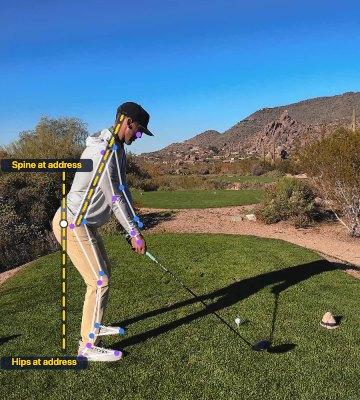
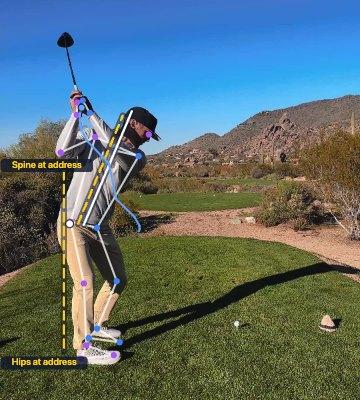
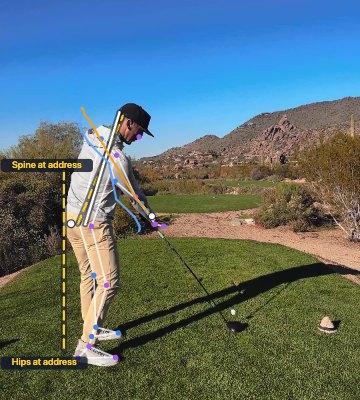
The club isn't tracked, so the swing is timed from the hands — the midpoint of both, which hold one club:
- The top is the hands' highest point once they have risen clearly above their height at address.
- The first move is the start of the unbroken movement of the hands that ends at the top. A simple “moved away from address” threshold reads two or three frames late, because the clubhead moves before the hands do.
- Impact is the first frame at or after the hands' lowest point on the way down. The low point is found between frames, through the three lowest samples, on the unsmoothed hands — smoothing would pull it early.
Any of them can be stepped a frame at a time and set by hand, and the tempo follows.
Why frame rate decides how exact it is
A downswing is short. In the example swing, filmed at 24 fps, it took 0.29 s — about seven frames. Moving impact by one frame changes the downswing by roughly a seventh, and the ratio with it. So the report gives tempo with its margin: one frame either side, at the frame rate you filmed.
| Example swing | Value |
|---|---|
| Backswing | 0.50 s |
| Downswing | 0.29 s |
| Tempo | 1.7 : 1 |
| Margin at 24 fps | ±0.4 |
The margin shrinks in proportion to the frame rate. By the same arithmetic, the same swing filmed at 60 fps would carry a margin of about ±0.15 rather than ±0.4. Most phones film at 60 fps; for tempo, it's worth turning on.
Reading the example
At 1.7 : 1 the example swing's backswing is quick relative to its downswing. Even at the top of its margin, 2.1, it sits under the view's 2.5–3.5 starting guide — a reading that survives the frame-rate uncertainty, which is what makes it worth discussing. Whether to change it is a coach's call; the number's job is to say whether a change happened.
Slow motion and comparing swings
Slow-motion clips work: the ratio is the same at any playback speed. The backswing and downswing times are read on the clip's own clock, though, so in slow motion they're the slowed-down times.
Tempo is most useful from one session to the next. File each swing under the golfer with People & progress, and put a swing from the start of a lesson beside one from the end with side-by-side comparison.
Questions
What is a good golf swing tempo?
About 3 : 1 is the figure most often quoted — a backswing three times as long as the downswing — and the golf view's starting guide is 2.5 to 3.5. It's a coaching starting point, not a rule.
How do I measure my golf tempo from a video?
Time the backswing from the first move to the top, and the downswing from the top to impact, then divide one by the other. Markerless finds those moments from the hands and reports the ratio with its margin at your frame rate.
What frame rate do I need to measure tempo?
The downswing is only about a quarter of a second, so at 24–30 fps one frame changes the ratio noticeably. 60 fps or more gives a much tighter figure, and most phones can film it.
Does slow-motion video change the tempo?
No. The ratio is the same at any playback speed. Only the backswing and downswing times are slowed down with the clip.