Markerless motion capture for rowing
Rowing technique on the erg, measured from one video
Film a piece on the rowing machine from the side and see every stroke as numbers: knee, hip, trunk and elbow angles on every frame, the catch and finish positions, and how the legs, body and arms sequence through the drive. No markers, no sensors on the handle — a phone on a tripod.
Plans from $29/month · Cancel any time
Indoor rowing · side-on
one real clip →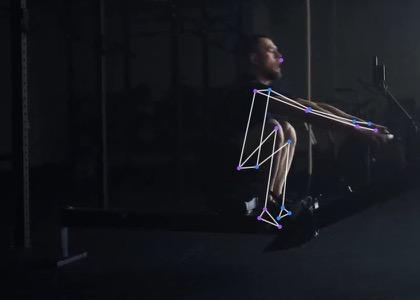
Catch
0:02.8
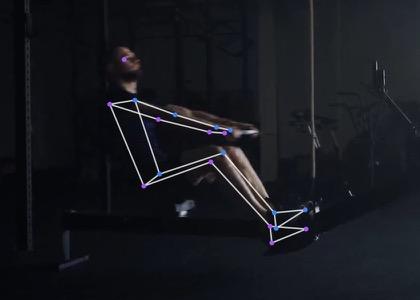
Drive
0:03.3
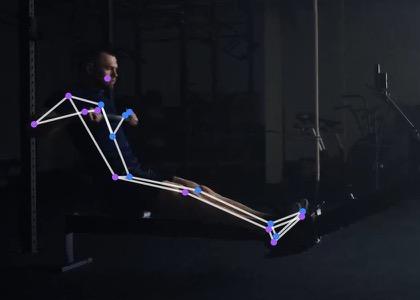
Finish
0:03.8
Through the stroke
| Stroke rate | 3 strokes | 23 spm |
| Drive : recovery | drive 41% of the stroke | 1 : 1.4 |
| Body swing | 7° over → 33° back | 40° |
Tagged
0:00.1Catch — body over 7° on average, short of the 20–35° guide
…every joint, every stroke, as JSON or CSV.
1
phone, filming side-on
14
joint angles per frame
Every
stroke measured
0
markers or sensors
Built for the way rowing is coached
The erg is made for one camera
The slide, the body swing and the draw all happen in one plane. Filmed square-on from the side, a single video sees the stroke the way a coach standing beside the machine does — with nothing to calibrate.
Numbers for what coaches already see
Body over at the catch, legs then body then arms on the drive, a held layback at the finish. Each becomes an angle you can read off every stroke, instead of a judgement made at full speed.
Every stroke, not a highlight
Measure the whole piece and compare its first strokes with its last — where the technique holds, and where it goes as the rower tires.
What it measures on the erg
The rowing stroke is a sequence. The value is in seeing each part of it as a number, stroke after stroke.
The catch
Knee and hip angle at full compression, and how far the body is over — "one o'clock" as a number. Spot over-compression, or a catch where the slide runs out before the body is set.
Range of motion→Drive sequencing
The rowing view times where the body starts to swing and the arms start to bend, as a share of the leg drive, on every stroke — so legs, body, arms is a number, and shooting the slide shows up as a body that waits until the legs are nearly down.
Angle charts→The finish and layback
How far the body swings back ("eleven o'clock"), whether the legs are fully down, and where the elbows finish as the handle comes in. Tag the catch and the finish and they're one click away on every review.
Tags and clips→Technique under fatigue
ProSave the first and last minute of a piece as clips and read them side by side — body swing shortening, compression creeping in, the arms taking over.
Side-by-side comparison→Each rower over time
File every session under the rower and follow their catch and finish angles from one training block to the next, left against right.
People and progress→Feedback they can open
Send the rower a view-only link to their own stroke — the video with the skeleton drawn on and the numbers beside it. No account needed to watch it.
Shareable links→
From a piece on the erg to numbers
- 01
Film side-on
Phone on a tripod at hip height, level with the middle of the slide and square to the machine, with the whole stroke — full compression to full layback — in frame.
- 02
Check the skeleton
The tracked skeleton is drawn over the video. Read the side nearer the camera: the far arm and leg are hidden behind the body and machine, and are flagged when their tracking jumps.
- 03
Read it as rowing
Pick the rowing view and every stroke is found for you — stroke rate, drive-to-recovery ratio, body angle and knee at the catch, layback at the finish, and where the body and arms come into the drive. Trim to the steady part and it follows.
- 04
Read and share
Angles for every joint through every stroke, as charts and as JSON or CSV — and a link to send the rower.
Stroke by stroke, in a spreadsheet
The angles CSV has one row per frame and one column per joint, timed from the start of the clip — enough to find each catch and finish, measure the timing of the drive, or average a block of strokes. The trunk's lean comes out in its own column, calculated from the landmarks; the file says which columns were calculated and which were measured.
Everything in the exports→Open a real report like this→# Strokes 12–14: 0:31.2–0:38.6 of 2k piece · side-on
frame,time_s,left_knee,left_hip,left_elbow
936,31.200,68.4,32.1,176.2
937,31.233,70.9,33.8,176.0
938,31.267,77.6,36.2,175.8
939,31.300,86.3,39.5,175.9
940,31.333,95.8,43.4,175.5Is it the right tool?
Worth knowing before you sign up, not after.
A good fit when
- The work is on a rowing machine, filmed from the side
- You want to follow technique over weeks — catch, body swing, sequencing — more than one absolute number
- You coach a squad and want every rower measured the same way, with no kit to fit
- You want the data out, to analyse in your own tools
Look elsewhere when
- You need force, power or handle-speed curves — those come from the erg's monitor or an instrumented handle, not from video
- You're filming on-water from a moving launch, where the camera can't stay square to the boat
- You need lab-grade 3D joint angles for publication without validating them yourself
- The rower can't be filmed side-on with their whole body in frame
Range of motion, tags, people and shareable links are on every plan, from $29/month. Comparing two pieces side by side and smoothing filters come with Pro ($59/month). Working alongside other coaches? Advanced includes 5 seats.
Compare plans→The features behind it
Range of motion
Fourteen joint angles, measured on every frame
Read more →Tags, comments and clips
Pin what you noticed to the frame where you noticed it
Read more →People & progress
Everyone you measure, session by session
Read more →Side-by-side comparison
ProTwo measurements, lined up on the same moment
Read more →Shareable links
Send a report or an exercise to anyone — no account needed
Read more →Take the data with you
JSON and CSV for everything, with the provenance attached
Read more →
Also see: Markerless motion capture for indoor cycling · How markerless motion capture works · Markerless for biomechanists
Questions, answered
Can you analyse rowing technique from a phone video?
Yes. On a rowing machine the stroke happens almost entirely in one plane, so a single phone filming side-on sees what matters: the catch, the drive, the finish and the recovery. Markerless tracks 33 body points on every frame and measures the knee, hip, elbow, shoulder and ankle angles — and the trunk's lean — from them.
Where should I put the camera?
Side-on and square to the machine, at about hip height, level with the middle of the slide, and far enough back that the whole stroke stays in frame from full compression to full layback. Read the side nearest the camera — the far arm and leg are hidden behind the body for much of the stroke.
What frame rate do I need?
Ordinary 30 frames per second is enough for positions — the catch, the finish, body angles. At high stroke rates the catch happens quickly, so 60 fps, which most phones can film, gives you twice as many frames around it.
Can it show the sequencing of the drive?
Yes, as timing rather than force. Knee, hip and elbow angles share one time axis, so you can see when each joint starts to open — legs first, then the body, then the arms — and catch shooting the slide, where the knees extend while the trunk angle hasn't moved.
Does it read power, split or stroke rate?
No — those come from the erg's own monitor. What Markerless adds is the body behind those numbers: the positions and timing that produce them.
Does it work for on-water rowing?
It can, when the camera stays square to the boat — from the bank as the crew passes, or a launch running level and alongside. A moving, angled camera breaks the side-on view the angles depend on, which is why the rowing machine is where markerless measurement is most reliable.
How accurate is it?
We haven't published a validation study against marker-based motion capture, so treat the angles as a consistent measure of what the camera saw rather than a lab-grade absolute. That makes them strongest for comparing an athlete with their own earlier sessions, filmed the same way — which is most of what coaching and fitting need.