Golf
Golf posture: spine angle at address
Coaches film from down the line to see posture: how far the golfer bends forward over the ball, how much the knees flex, and whether that shape survives the swing. Here is what each of those is as a number, what the golf view reads from a phone video, and where a single camera stops.
What spine angle means here
Pose models have no points along the spine, so “spine angle” is the line from the middle of the hips to the middle of the shoulders, measured forward of vertical. Upright reads 0°; bending over the ball increases it. It is the trunk's lean as a whole, not the curve of the back — a rounded and a straight back with the same lean read the same.
Knee flex is the trail knee's angle between thigh and shin, on the site's usual scale where a straight leg reads 180°. The more flex at address, the smaller the number.
At address
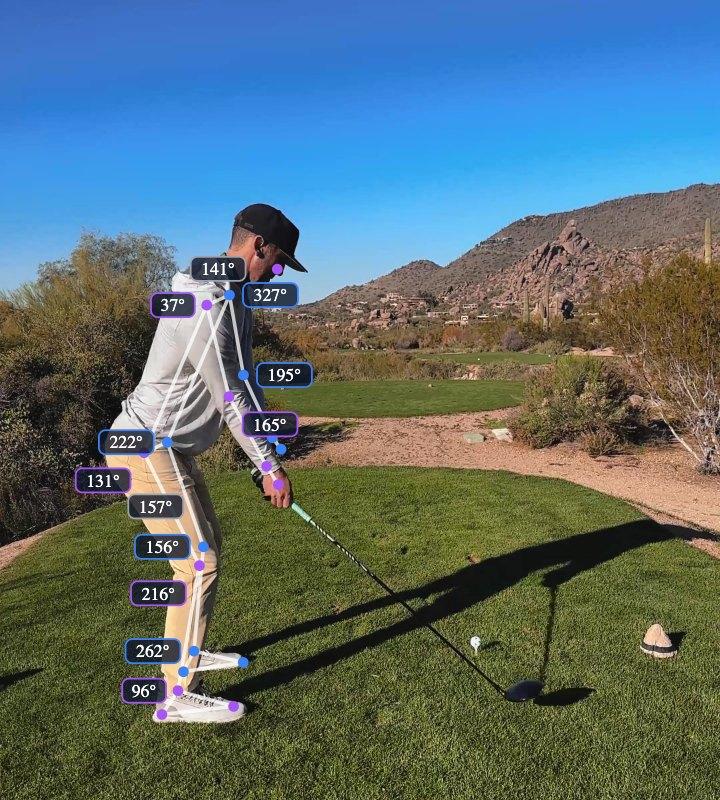
The golf view reads the spine bend and the trail knee at address, averaged over three frames so one jittery frame cannot set the baseline. There is no right number to aim for: build, club and coaching style all change it, and a systematic review of golf swing kinematics found too little agreement between studies to generalise their results. What matters more is the next section — whether the posture you set up in is the one you strike the ball from.
Holding the posture to impact
Posture held is the spine angle at impact minus the spine angle at address. Negative means the golfer stood up out of their posture; positive means they bent further over. The view's starting guide is within ±5°, a coaching starting point rather than a rule.
The spine is also read at the top of the backswing, so a posture that is lost going back and recovered coming down shows up as well as one that is lost on the way into the ball.
Early extension: the hips toward the ball
Early extension is the pelvis moving towards the ball in the downswing, so the golfer has less room for the arms and often stands up at the same time. The view measures it directly: how far the middle of the hips has moved toward the ball at impact compared with address, with the address lines held on the video so the move is visible as well as numbered.
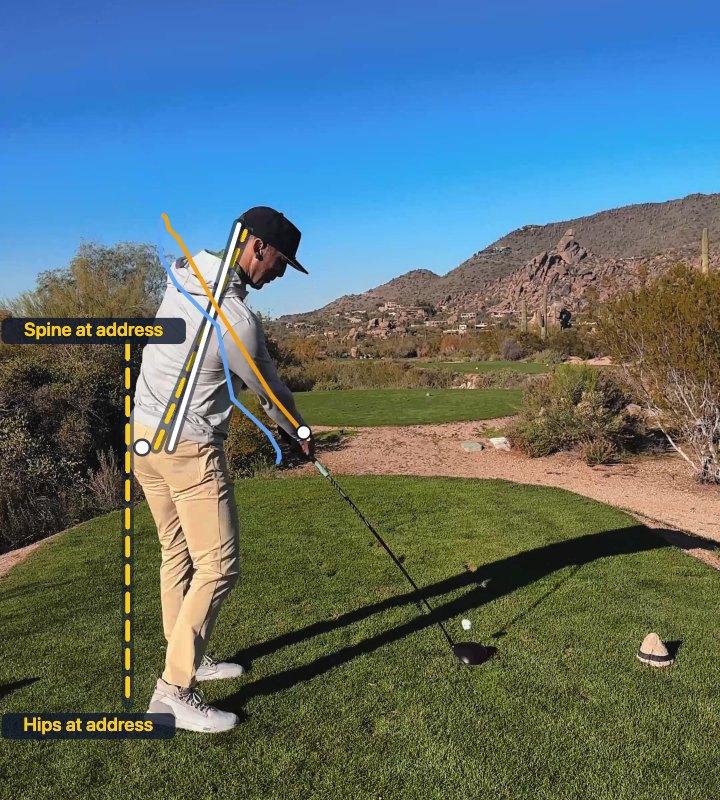
Distances are in centimetres, scaled from the golfer's height: the leg from hip to ankle is taken as 0.491 of standing height. The starting guide is no more than 5 cm toward the ball. In the example swing the hips came 7.5 cm toward the ball by impact — over the guide, and the kind of reading worth a look on the video before anything else.
Head drop sits beside it: how far the head has moved down (or up) at impact from address, with a starting guide of within ±5 cm.
The trail knee
Down the line also shows whether the trail knee keeps its flex into the top. The reading is how many degrees straighter it is at the top than at address, with a starting guide of no more than 15°. The example swing's trail knee straightened by 24° by the top.
How to film down the line
- Put the phone on a tripod behind the golfer, on the target line, at about hand height.
- Keep the whole golfer in frame from address to the finish, with room above the head for the club.
- Film at 60 fps or more if the phone can; 24–30 fps is enough for the positions read here.
- In the report, pick Golf — back view, and check address, the top and impact against the video. Any point a frame out can be stepped to the right frame and set by hand, and every reading follows.
The view also checks the camera: down the line, the shoulders look narrow next to the torso, and if they look wide it warns that the clip may have been filmed face on.
What one camera can't tell you
- It's 2D. Lean toward or away from the camera is foreshortened, which is why the camera has to sit on the target line.
- Positions, not the blur. The fastest part of the swing blurs at ordinary frame rates, so positions are read at address, the top, impact and the finish — never mid-downswing. Only the hands' path is drawn through it.
- No club, no ball. The club isn't tracked; clubhead speed, face and launch come from a launch monitor.
- One swing at a time. The view reads the first full swing in the section; trim the report to read another.
Questions
What is a good spine angle at address in golf?
There isn't one number. Build, club and coaching style all change it, and research on golf swing kinematics hasn't agreed on one. The more useful reading is whether the golfer holds the angle they set up with through to impact.
What is early extension in golf?
The hips moving toward the ball during the downswing, so the golfer loses the room their arms need and often stands up. From a down-the-line video it shows as the middle of the hips ending up closer to the ball at impact than at address.
How do I know if I stand up out of my posture?
Film down the line and compare the trunk's forward lean at impact with its lean at address. A negative difference of more than a few degrees means you stood up. The golf view reports it as Posture held.
Can I measure golf posture from a phone video?
Yes, from behind on the target line with the phone on a tripod. The spine's forward lean and the knee angles come from the tracked body points; the club itself isn't tracked.
References
Bourgain, M., Rouch, P., Rouillon, O., Thoreux, P., & Sauret, C. (2022). Golf Swing Biomechanics: A Systematic Review and Methodological Recommendations for Kinematics. Sports, 10(6), 91.
Reviews 92 studies of golf swing kinematics and finds no methodological consensus, which left their performance results contradictory — the reason the numbers here are starting guides, not norms.
doi:10.3390/sports10060091