Rowing
The rowing catch and finish, as angles
Every rowing stroke runs between two positions: the catch at the front, compressed and reaching, and the finish at the back, legs down and body swung through. Coaches describe both in shorthand: "one o'clock", "shins vertical", "arms long". Each of those is an angle, and a phone filming the erg side-on can measure it on every stroke.
Two positions, one stroke
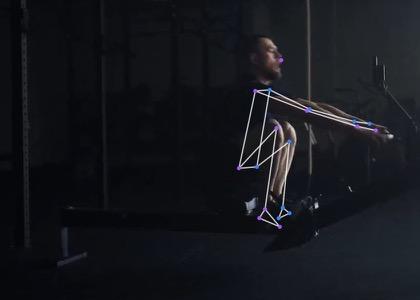
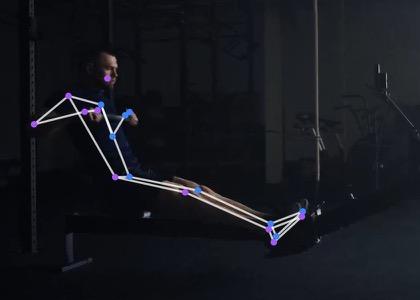
The catch is the front of the stroke, where the blade would enter the water. The legs are fully compressed, the body leans forward from the hips and the arms are straight. The finish is the back: the legs are flat, the body has swung back past upright and the handle has been drawn into the body.
The drive takes the rower from the catch to the finish: legs, then body, then arms. The recovery reverses it: arms, then body, then slide. Most technique work is about arriving at these two positions well and in the right order, which is why they're worth measuring rather than judging at full speed.
The clock face
Coaches often describe the body's angle as a clock hand seen from the side, with twelve o'clock straight up: about one o'clock at the catch (leaning forward) and about eleven o'clock at the finish (leaning back). That's a coaching convention, not a measured standard, and coaches differ on it.
The conversion is arithmetic. A clock face is 360° over twelve hours, so each hour is 30°, and one o'clock or eleven o'clock is about 30° either side of vertical.
| Position | Coaching shorthand | Trunk from vertical | Rowing view's starting guide |
|---|---|---|---|
| Catch | About one o'clock | About 30° forward | 20–35° forward |
| Finish | About eleven o'clock | About 30° back | 20–40° back |
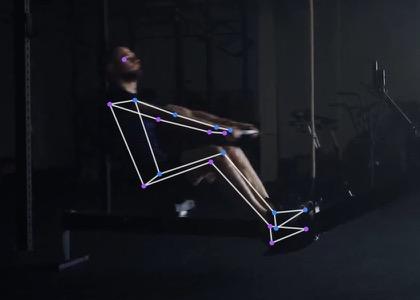
In our example clip the rower swung 40°, from 7° over at the catch to 33° back at the finish. Against the guides that's a short reach forward and a finish inside the range, which is exactly the sort of thing a number makes easy to talk about. The camera was a little off side-on there, and the report flags those angles as approximate.
At the catch
- Body over. The trunk is set forward from the hips before the slide comes up, so the reach comes from the hips, not from slumping the shoulders.
- Shins near vertical. Compression stops with the shins about upright. The rowing view's starting guide keeps the shin within a few degrees of vertical. Past that, the rower is over-compressed.
- Knees and hips closed. The knee is at its most bent in the stroke, which is how the rowing view finds each catch. The hip is closed between the trunk and the thigh.
- Arms long. The elbows are straight or nearly so. The rowing view's guide is 160° or more, where 180° is a straight arm.
At the finish
- Legs down. The knees are flat or nearly so. The guide is 165° or more at the finish.
- Body back. The trunk has swung past upright to about eleven o'clock, with the core holding it there rather than collapsing back.
- Handle in. The elbows are at their most bent as the handle reaches the lower ribs, which is how the rowing view finds each finish when the arms are measured.
Reading them in Markerless
Markerless measures every joint as the angle between its two segments, so a straight arm or leg reads 180°. The trunk is measured against vertical at the midpoint of the hips. In the angle charts and downloads it's the low_back figure, where 180° is upright.
Which way it reads depends on which side faces the camera. Filmed from one side, a trunk 30° forward reads 150°. Filmed from the other, the same posture reads 210°, which is 360° minus the first. The rowing view does that conversion for you and reports the body angle in degrees forward or back from vertical, stroke by stroke.
Values at the catch and the finish are read with a fit through the frames around each extreme, so smoothing doesn't shave them. Tag a catch and a finish once and they're a click away on every review. Save the first and last minute of a piece as clips and compare them to see what the position does under fatigue.
Filming for it
- Phone on a tripod, side-on and square to the machine, at about hip height and level with the middle of the slide.
- Far enough back that the whole stroke, from full compression to full layback, stays in frame.
- Read the side nearer the camera. The far arm and leg are hidden behind the body for much of the stroke.
- Ordinary 30 fps is enough for positions. At high rates the catch is quick, so 60 fps gives twice the frames around it.
What the angles leave out
Positions aren't the whole stroke. Force, power and handle-speed curves come from the erg's monitor or an instrumented handle, not from video. Some of what matters happens out of the side-on plane. In a 3D lab study of twenty elite rowers (Buckeridge et al.), asymmetry at the foot-stretchers was tied to lumbar-pelvic motion and pelvic twist, which a single side-on camera can't see.
It's also worth being plain about the positions themselves. A major review of rowing biomechanics (Soper and Hume) found the biomechanical predictors of 2,000 m performance indistinct in the literature, with little research on what the ideal technique is. One o'clock and eleven o'clock are good shared language, and measuring a rower against their own earlier strokes is where the numbers are most useful.
Questions
What is the catch in rowing?
The front of the stroke: legs fully compressed, body leaning forward from the hips, arms straight, just before the drive begins. On the water it's where the blade enters; on the erg it's the moment the knees are most bent.
What does one o'clock mean in rowing?
It's coaching shorthand for the body's angle at the catch, read like a clock hand seen from the side with twelve straight up. One hour is 30°, so one o'clock is about 30° forward of vertical. Eleven o'clock, used for the finish, is about 30° back.
How far should you lean back at the finish?
Many coaches teach about eleven o'clock, roughly 30° back from vertical. The rowing view uses 20–40° as its starting guide. Coaches differ, and a held, controlled finish matters more than the exact figure.
Should your shins be vertical at the catch?
That's the common coaching cue: compress until the shins are about upright and no further. Going past vertical is called over-compression. Measured side-on, the shin's angle from vertical is a number you can check on every stroke.
Can I measure my rowing technique with my phone?
Yes, on an erg. Film side-on from a tripod at hip height with the whole stroke in frame, and the body, knee, hip and elbow angles at every catch and finish can be read from the video.
References
Soper, C., & Hume, P. A. (2004). Towards an ideal rowing technique for performance. Sports Medicine, 34(12), 825–848.
A review of rowing biomechanics. It finds the biomechanical predictors of 2,000 m performance indistinct in the literature, and little research on what the ideal technique is.
doi:10.2165/00007256-200434120-00003
Buckeridge, E. M., Bull, A. M. J., & McGregor, A. H. (2015). Biomechanical determinants of elite rowing technique and performance. Scandinavian Journal of Medicine & Science in Sports, 25(2).
Twenty elite female rowers on an instrumented erg with 3D motion capture. Hip kinematics was a key predictor of foot force, and foot-stretcher asymmetry related to lumbar-pelvic motion and pelvic twist.
doi:10.1111/sms.12264