Bike fit
Knee angle at the bottom of the pedal stroke
The knee angle at the bottom of the pedal stroke is the number most saddle-height decisions start from. There are two published starting ranges for it, and they disagree by several degrees. The reason is how it was measured: with the rider sitting still, or while they pedal. Here's what each range means, how to convert it to the 180°-is-straight scale Markerless reports, and how to measure it from a phone on a tripod.
What the number is
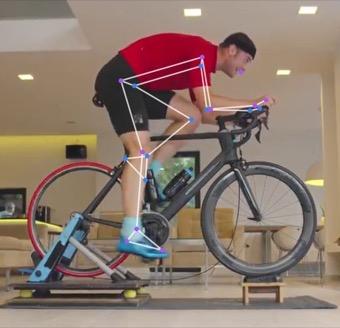
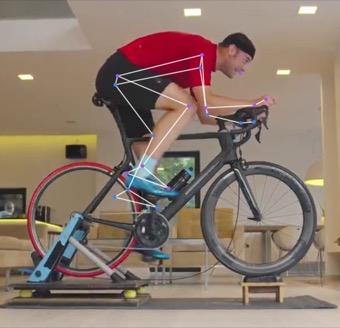
It's the angle between the thigh and the shin when the pedal is at its lowest point — bottom dead centre, the crank at six o'clock. Saddle height drives it most. Cleat position, how far the rider drops the heel and crank length move it too.
Fitters usually quote it as knee bend: 0° is a straight leg and the number is how far the knee is from straight. Markerless reports the angle between the two segments instead, so a straight leg reads 180°. Converting is a subtraction: bend = 180° − the Markerless reading.
| Knee bend (fitter's figure) | Markerless reading |
|---|---|
| 25° | 155° |
| 30° | 150° |
| 35° | 145° |
| 40° | 140° |
| 43° | 137° |
The static range: 25–35°
The longest-standing guide is the Holmes method, from Holmes, Pruitt and Whalen's 1994 paper on overuse in cycling. It calls for 25–35° of knee bend with the pedal at the bottom, measured while the rider sits still. That's 145–155° in Markerless's convention, and it's the starting range the cycling view shows beside its figures.
Static has one great virtue: it's quick. Its weakness is that nobody rides with the crank parked at six o'clock. A pedalling rider moves the ankle, shifts on the saddle and drops the heel differently from how they sit for a measurement.
Measured while pedalling, it reads more bent
Millour and colleagues (2019) filmed 26 cyclists in 2D and compared the methods directly. With the pedal at the bottom, the knee was 8° more bent while pedalling than in the static position. It was also 3° more bent at bottom dead centre than at its straightest point in the stroke. Their conclusion was a separate dynamic range of 33–43° at the bottom of the stroke.
Ferrer-Roca and colleagues (2012) worked from a 30–40° range, taken at the knee's straightest point on 2D video of the rider pedalling. On video, 26% of their riders fell outside it, and the authors concluded that setting the saddle from inseam length alone may not put the knee inside it. A 2022 systematic review of 41 studies, by Bini and Priego-Quesada, found strong evidence for setting saddle height from dynamic knee-angle measurements.
| Range | How it's measured | Knee bend | Markerless reading |
|---|---|---|---|
| Holmes method | Rider still, pedal at the bottom | 25–35° | 145–155° |
| Ferrer-Roca et al. | Pedalling, knee at its straightest | 30–40° | 140–150° |
| Millour et al. | Pedalling, pedal at the bottom | 33–43° | 137–147° |
Which one Markerless reads
The cycling view takes the knee at its straightest in each revolution, which is how it finds the bottom of the stroke on video. That's the same point the 30–40° range is taken at, and by Millour's figures it reads about 3° less bent than the exact moment the crank is vertical. So read it against the dynamic ranges, and above all against your own earlier measurements made the same way.
The top of the stroke
As the pedal comes over the top, the knee is at its most bent and the hip at its most closed. Saddle height, setback and crank length all show here. There's no single published range for the top that compares with the ones above, so treat it as a number to track rather than to hit.
In our example clip the rider's knee read 158.4° at the bottom (21.6° of bend), ±2.2° across 33 strokes, and 74.6° at the top. Where that sits for this rider is a fitter's call, made with the rider in front of them.
How to film it
- Put the bike on a trainer, smart bike or rollers, so it stays in one place relative to the camera.
- Phone on a tripod, side-on and square to the bike, at about hip height and level with the bottom bracket. If the wheels look round rather than oval, you're square.
- Get the whole rider and bike in frame. Shorts or fitted kit make the knee and ankle easy to track.
- Film the side you want to measure. The far leg is hidden behind the bike for much of the stroke.
- Let the rider settle at their usual cadence and effort, then film 15–30 seconds of steady pedalling.
Frame rate matters less than you'd think. At 90 rpm the cranks turn 540° a second, so 30 fps gives a frame every 18° of crank rotation and 60 fps every 9°. The knee changes slowly near the bottom of the stroke, and the cycling view reads each bottom with a five-point fit through the frames around it, so 30 fps is usually enough. Use 60 fps for high cadences or for reading the ankle.
Reading it stroke by stroke
A short clip holds dozens of revolutions. The bottom of each one is the knee's peak, and the useful figures are the average across the steady strokes and the spread around it. The cycling view gives both, plus a chart of every stroke you can click to watch.
If you export the angles and smooth them yourself, choose the filter carefully. Smoothing shaves peaks, and this number is a peak. A moving average takes 2–3° off the knee at the bottom, which is a whole fitting decision. A zero-lag Butterworth or a Savitzky–Golay filter keeps peaks where they are. See smoothing filters for the trade-offs.
Before and after a change
The strongest use of the number is comparison. Change one thing, such as saddle height, film again exactly the same way and put the two clips side by side. Filed under the rider in People, every fit keeps its history: what changed, when, and what the knee did.
Keep the camera where it was. A different height or angle changes the reading as surely as a different saddle height does.
What a side-on video can't tell you
- It's a 2D angle in the plane of pedalling. Knee tracking — the knee moving in and out over the pedal — happens in the frontal plane and needs a front-on view. The keypoints show its path there, but it isn't a single number we report.
- It isn't a goniometer on bony landmarks. A camera's angle and a goniometer's are different measurements, so compare against your own earlier clips filmed the same way, not against someone else's tape measure.
- It reads the near leg. The far leg is hidden behind the bike. Film each side separately if you want both.
- It doesn't decide the fit. Comfort, flexibility, injury history and goals matter as much as any number.
Questions
What knee angle should I have at the bottom of the pedal stroke?
Fitters commonly start from 25–35° of knee bend measured with the rider still (the Holmes method), or around 30–40° measured while pedalling. In Markerless's convention, where a straight leg is 180°, that's roughly 145–155° static and 140–150° dynamic. They're starting points for a fitter to adjust from, not targets.
Why does the knee angle read differently when pedalling?
A rider moves the ankle and settles on the saddle differently while pedalling than when sitting still for a measurement. One study of 26 cyclists found the knee 8° more bent at the bottom of the stroke while pedalling than in the static position.
How do I convert a Markerless knee angle into knee bend?
Subtract it from 180. A Markerless reading of 150° is 30° of knee bend. If the raw reading is over 180° because the rider was filmed from the other side, subtract 180 from it instead. The cycling view does this for you.
Is 30 fps enough to measure the knee at the bottom of the stroke?
Usually, yes. At 90 rpm 30 fps gives a frame every 18° of crank rotation, the knee changes slowly near the bottom, and each bottom is read with a fit through the frames around it. Film at 60 fps for very high cadences or if you want the ankle.
Does saddle height change the knee angle much?
Yes. It's the main thing that sets it, which is why the knee angle is used to set saddle height. Film before and after a change in exactly the same way, and the difference in the knee reading is the effect of the change.
References
Holmes, J. C., Pruitt, A. L., & Whalen, N. J. (1994). Lower extremity overuse in bicycling. Clinics in Sports Medicine, 13(1), 187–203.
Cited as the source of the Holmes method: 25–35° of knee bend with the pedal at the bottom, measured with the rider still.
doi:10.1016/s0278-5919(20)30363-x
Millour, G., Duc, S., Puel, F., & Bertucci, W. (2019). Comparison of static and dynamic methods based on knee kinematics to determine optimal saddle height in cycling. Acta of Bioengineering and Biomechanics, 21(4), 93–99.
Twenty-six cyclists filmed in 2D: the knee read 8° more bent at the bottom while pedalling than in the static position, and the authors propose 33–43° for the dynamic case.
doi:10.37190/abb-01428-2019-02
Ferrer-Roca, V., Roig, A., Galilea, P., & García-López, J. (2012). Influence of saddle height on lower limb kinematics in well-trained cyclists. Journal of Strength and Conditioning Research, 26(11), 3025–3029.
Compares setting the saddle from inseam length with 2D video of the rider pedalling, against a 30–40° knee-bend range: 26% of riders fell outside it on video.
doi:10.1519/jsc.0b013e318245c09d
Bini, R., & Priego-Quesada, J. (2022). Methods to determine saddle height in cycling and implications of changes in saddle height in performance and injury risk: A systematic review. Journal of Sports Sciences, 40(4), 386–400.
Forty-one studies reviewed. Finds strong evidence for setting saddle height from dynamic knee-angle measurements.
doi:10.1080/02640414.2021.1994727
Bini, R., Hume, P. A., & Croft, J. L. (2011). Effects of bicycle saddle height on knee injury risk and cycling performance. Sports Medicine, 41(6), 463–476.
The narrative review that the 2022 systematic review updates — the place to start on saddle height and the knee.
doi:10.2165/11588740-000000000-00000