Range of motion · Shoulder
Shoulder range of motion: normal values
The shoulder moves further than any other joint in the body, which is exactly why it is hard to measure well. Here are the published reference values for shoulder flexion, how a goniometer measures it, and how to measure the same movement from an ordinary video — front-on for raising the arm out to the side, side-on for raising it forwards.
The movements
- Flexion — raising the arm forwards and up, towards overhead.
- Extension — taking the arm back, behind the body.
- Abduction — raising the arm out to the side and up.
- Adduction — bringing it back in towards and across the body.
- Internal and external rotation — turning the arm about its own long axis, as when reaching behind the back or cocking the arm to throw.
The first four swing the upper arm through a plane. Rotation turns it in place, which matters below: a camera sees a swing clearly and a turn hardly at all.
Reference values
| Motion | Women 20–44 | Men 20–44 | Women 45–69 | Men 45–69 |
|---|---|---|---|---|
| Shoulder flexion | 172.0° | 168.8° | 168.1° | 164.0° |
Of the shoulder's movements, the study measured flexion only. Abduction and rotation were not part of it, so this page quotes no norm for them rather than borrow one from a different method.
How it is measured with a goniometer
A goniometer is a protractor with two arms. For shoulder flexion, the pivot is lined up with the shoulder joint, one arm is held along the side of the trunk and the other along the upper arm, and the angle between them is read once the arm has gone as far as it will. Abduction is the same idea seen from the front or back.
It is quick and cheap, and it is also a measurement with its own error: where the pivot sits, how the arms are lined up and how the person is positioned all move the number. That is why a goniometer reading is best compared with another taken the same way.
How Markerless measures the shoulder
The shoulder angle is made from three tracked points: the elbow, the shoulder and the hip. It is the angle at the shoulder between the upper arm and the line down the side of the trunk — the same two lines a goniometer is lined up with.
So the reading follows how far the arm is raised from the trunk. In the shoulder abduction example, filmed front-on, the left shoulder reads 19.8° with the arm by the side and 162.4° at the top of the lift; the right reads 19.2° and 173.7°. The resting figure is not 0° because the elbow and the hip never sit exactly in line in the picture, so read the change from the person's own starting position rather than the raw number.
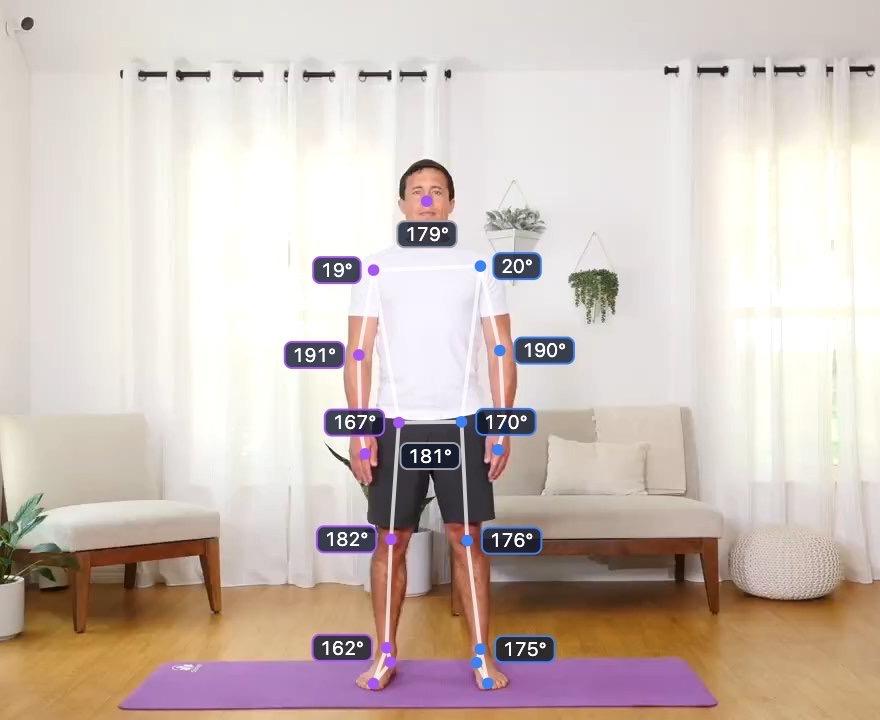
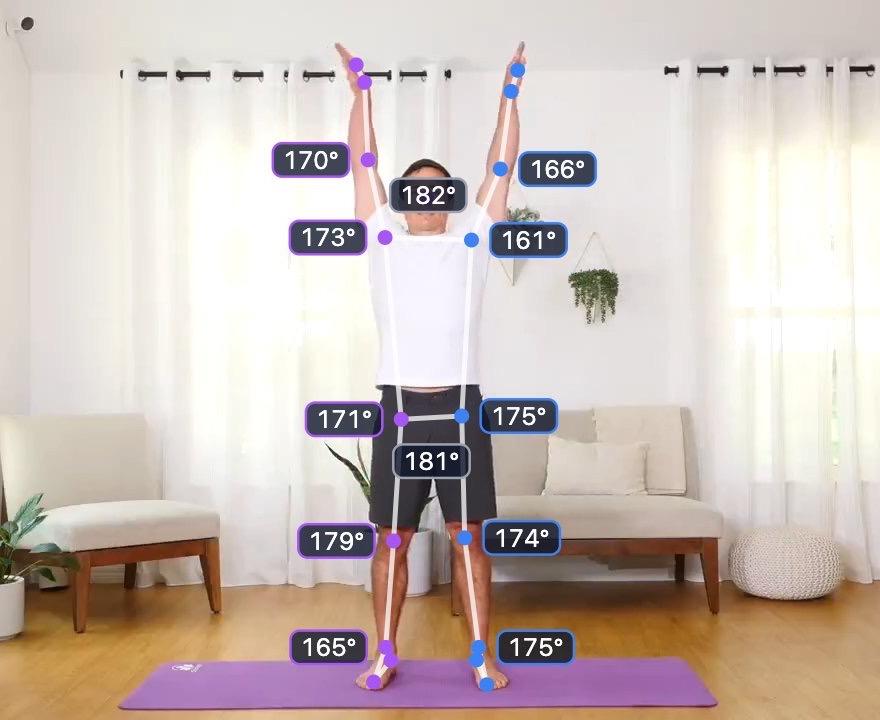
The camera decides which movement you are reading. Front-on, the angle shows abduction. Side-on, the same three points show flexion and extension. Taking the arm behind the body carries the reading the other way through 0°/360°, which the report writes as a range whose minimum is greater than its maximum — a range that wraps, not a mistake.
Filmed front-on, a person's two sides are mirror images in the picture, so the same movement reads x on one side and 360 − x on the other. The report flips the mirrored side back so left and right sit on the same scale; the downloads keep the engine's own clockwise angles.
How to film it
- Choose the view for the movement: front-on for abduction, side-on for flexion.
- Put the camera at about shoulder height, square to the person, not looking up or down at them.
- Keep the hips in frame as well as the arms — the hip is one of the three points.
- Wear something fitted at the shoulders, so the model can see where the joint is.
- Raise the arm in the plane the camera faces, not angled towards or away from it.
- Film the same way every time, so this session compares with the last one.
What video cannot measure
Angles are measured in two dimensions, from the camera's point of view. Anything that happens towards or away from the camera reads short, and a turn about the arm's own axis barely registers at all.
- Internal and external rotation — the arm turns in place, so the three points hardly move.
- Horizontal abduction and adduction — the arm swings towards and away from a front-on camera.
- The shoulder blade on its own — the model tracks the shoulder joint, not the scapula.
- Shrugging and leaning — both change the reading; check the trunk angle alongside it.
Questions
What is normal shoulder range of motion?
In the CDC's reference study, mean shoulder flexion was 172.0° for women and 168.8° for men aged 20 to 44, and 168.1° and 164.0° at 45 to 69. Those are averages; plenty of people sit either side of them.
Can I measure shoulder range of motion at home without a goniometer?
Yes, with a phone on something steady. Film side-on to measure raising the arm forwards, or front-on for raising it out to the side, with the hips in frame. Markerless tracks the elbow, shoulder and hip in every frame and reports the angle between the upper arm and the trunk.
How accurate is a shoulder range of motion app?
It depends on the app, the joint and above all the filming. Markerless has not published a validation study against a goniometer or marker-based capture, so treat its shoulder angles as a consistent measure of what the camera saw rather than a clinical absolute. They are strongest for comparing someone with their own earlier clips, filmed the same way.
Does a shoulder reading outside the reference range mean something is wrong?
No. Reference values are averages from one study's sample, and individuals vary well beyond them. A number from a video is a measurement, not a diagnosis. If movement is painful or has changed, that is a question for a qualified clinician, not for a chart.
References
Soucie, J. M., Wang, C., Forsyth, A., Funk, S., Denny, M., Roach, K. E., Boone, D., & the Hemophilia Treatment Center Network (2011). Range of motion measurements: reference values and a database for comparison studies. Haemophilia, 17(3), 500–507.
The CDC's Normal Joint Range of Motion Study: goniometer measurements of people without conditions affecting joint mobility, published by sex and age group. Every reference value on these pages is copied from its tables.
doi:10.1111/j.1365-2516.2010.02399.x
Gajdosik, R. L., & Bohannon, R. W. (1987). Clinical measurement of range of motion. Physical Therapy, 67(12), 1867–1872.
A review of goniometry with the emphasis on its reliability and validity: a goniometer reading is itself a measurement with its own error, not a ground truth to compare everything else against.
doi:10.1093/ptj/67.12.1867
Keogh, J. W. L., Cox, A., Anderson, S., Liew, B., Olsen, A., Schram, B., et al. (2019). Reliability and validity of clinically accessible smartphone applications to measure joint range of motion: A systematic review. PLOS ONE, 14(5), e0215806.
A systematic review of how smartphone apps for measuring joint range of motion have been tested for reliability and validity — the place to start if you are choosing one.
doi:10.1371/journal.pone.0215806