Example analysis
Rowing technique analysis: an example
Nine seconds of a rower on an erg, filmed from the side on a phone. Three strokes, read by the rowing view for rhythm, the positions at the catch and the finish, and the order the legs, body and arms work in.
The clip
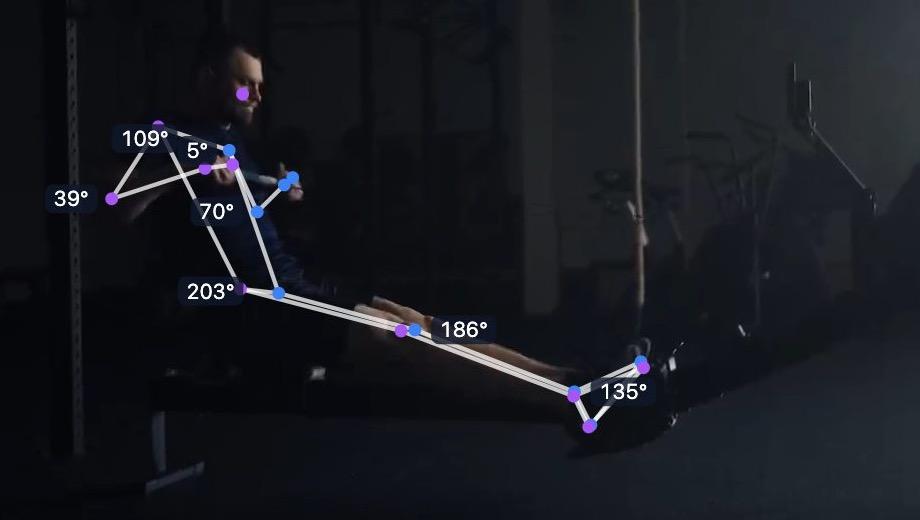
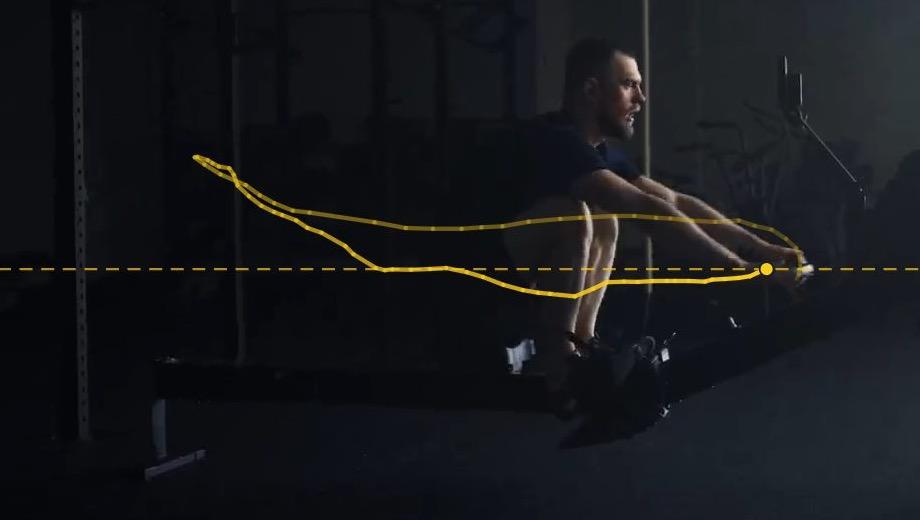
| Figure | What it is |
|---|---|
| 23 spm | Stroke rate, 3 strokes |
| 1 : 1.4 | Drive to recovery |
| 40° | Body swing, 7° over to 33° back |
| 271 | Frames, every one measured |
The camera was a little off side-on, and the report says so — it flags the angles as approximate rather than hiding it.
Rate and rhythm
23 strokes a minute, with a drive-to-recovery ratio of 1 : 1.4 — the drive took 41% of each stroke, a little above the 30–40% guide. A longer recovery than drive is the usual shape; at a low rate, coaches typically look for the recovery to stretch further still.
The catch and the finish
| Position | Reading | Guide | |
|---|---|---|---|
| Catch: body over, forward of vertical | 7° | 20°–35° | below |
| Catch: shins off vertical | 3° | −10°–5° | in guide |
| Catch: arms long (elbow) | 175° | 160° or more | in guide |
| Finish: layback from vertical | 33° | 20°–40° | in guide |
| Finish: legs down (knee) | 179° | 165° or more | in guide |
| Finish: handle height, hip 0% → shoulder 100% | 87% | 55%–85% | above |
The body swing was 40° in all, 7° over to 33° back: most of it at the finish, little of it at the catch. The body arrived at the front nearly upright. The catch and finish, in angles covers what each of these readings is.
Sequence
| Check | Reading | Guide | |
|---|---|---|---|
| Legs → body: leg drive done when the body opens | 20% | 60% or more | below |
| Body → arms: body swing done when the arms bend | 80% | 60% or more | in guide |
| Seat ahead of the handle in the drive | 5.3 cm | 3.0 cm or less | above |
Two readings point the same way. The body began to open when only a fifth of the leg drive was done, and the seat got 5.3 cm ahead of the handle on average — 10.6 cm on the first stroke — which is the seat moving without the handle. Those are what opening the back early and shooting the slide look like in numbers. The arms, by contrast, waited for the body.
Speeds through the drive show the same order. The seat peaked at 1.24 m/s 54% of the way through the drive, the trunk at 0.82 m/s at 51%, the arms at 1.63 m/s at 90%, and the handle at 2.91 m/s at 74%. Speeds are scaled from the rower's height, so the report says to read them to about 10% — the order of the peaks is the point.
What the report says about itself
The camera was a little off side-on, and the report flags its angles as approximate rather than hiding it. It also says which side it read — the right, the side nearest the camera by depth — with the rower facing right.
Open the full report
The shared report is the real thing, view-only: play the video with the skeleton over it, scrub the charts, and read every joint on every frame. Nothing to sign up for.