Example analysis
Video bike fit: an example analysis
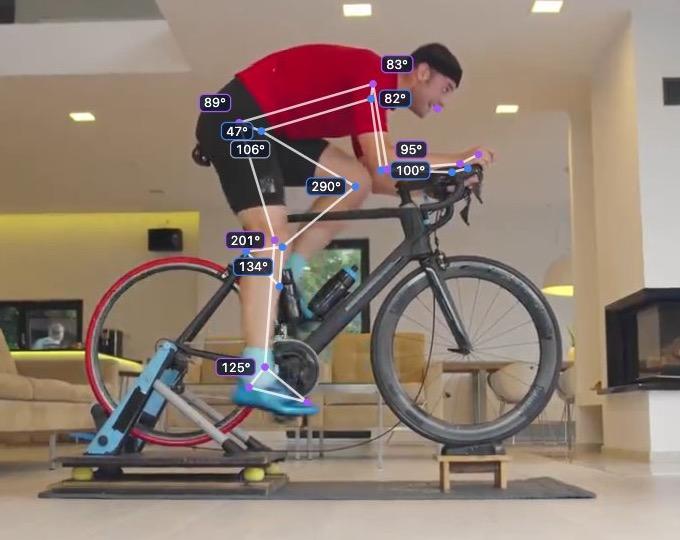
Twenty seconds of a rider on a turbo trainer, filmed side-on with a phone. The cycling view read 33 pedal strokes from the leg nearest the camera — here the right, chosen by depth — with the rider facing right.
The clip
| Figure | What it is |
|---|---|
| 104 rpm | Cadence, 33 strokes |
| 158.4° | Knee at the bottom, ±2.2° |
| 74.6° | Knee at the top |
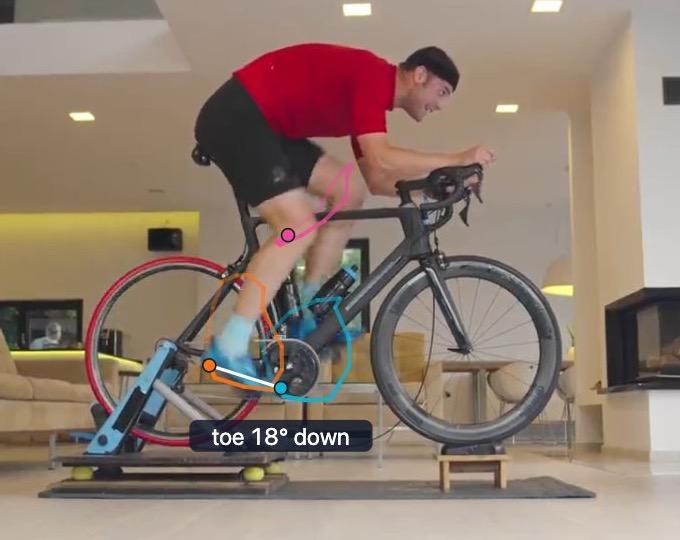
| 10° → 39° | Toe down, bottom to top of the stroke |
The report picks the leg nearer the camera on its own — here the right, by depth — and reads every stroke from it.
The knee at the bottom and top
| Reading | Average | Spread over 33 strokes |
|---|---|---|
| Knee at the bottom | 158.4° | ±2.2° · 154–162° |
| Knee at the top | 74.6° | ±1.5° · 71–77° |
| Hip at the top (most closed) | 36.8° | — |
| Cadence | 104 rpm | from the video |
At its straightest, the knee averaged 158.4° — about 22° of bend. Fitters measuring a rider while they pedal often start from 30–40° of bend there, 140–150° in this convention, so this knee straightens further than that starting point. Whether that matters is the fitter's call: comfort, flexibility and goals decide it, and the range is a place to start adjusting from, not a target. Knee angle at the bottom of the pedal stroke explains where the ranges come from.
The spread is the useful part of measuring every stroke. Across 33 strokes the bottom reading varied by ±2.2°, so a change after moving the saddle that is smaller than that is within the rider's own stroke-to-stroke variation.
Through the stroke
| Joint | Range through the average stroke |
|---|---|
| Knee | 75° – 159° |
| Hip | 37° – 88° |
| Ankle | 91° – 126° |
The ankle moved through 41.5° per stroke. The foot's own angle in the picture, from level, had the toe 10° down at the bottom of the stroke and 39° down at the top. The report notes that these are angles from level in the picture, so a camera that isn't level tilts them too.
What it can't tell you
A side-on view measures the angles in the plane of pedalling. Knee tracking — the knee moving in and out over the pedal — needs a front view, and power, pedal force and left-right balance come from a power meter or smart trainer rather than a camera. Bike fit from video covers what a number can and can't decide.
Open the full report
The shared report is the real thing, view-only: play the video with the skeleton over it, scrub the charts, and read every joint on every frame. Nothing to sign up for.